
Briefing

This pivotal research addresses the fundamental memory constraints inherent in modern zero-knowledge proof (ZKP) systems, where prover memory typically scales linearly with computation trace length. The paper introduces the first sublinear-space ZKP prover, significantly reducing memory requirements from linear to O(sqrt(T)) by reframing proof generation as a Tree Evaluation problem. This breakthrough enables ZKP deployment on resource-constrained devices and facilitates large-scale verifiable computation, fundamentally reshaping the landscape of privacy-preserving technologies and decentralized architectures.
The image presents a detailed, close-up view of a complex, futuristic-looking machine core, characterized by interlocking metallic rings and white structural elements. At its heart, a dynamic cluster of white, spiky particles appears to be actively manipulated or generated, surrounded by intricate mechanical components

Context

Prior to this work, a significant theoretical limitation in ZKP systems involved the prover’s memory footprint, which scaled linearly with the complexity of the computation it aimed to prove. This linear scaling posed a substantial barrier, rendering ZKPs impractical for widespread adoption on devices with limited computational resources and prohibitively expensive for extensive computational tasks. This challenge restricted the pervasive integration of verifiable computation into many real-world applications.

A modern office desk with two computer monitors and an office chair is depicted, partially submerged in a floor of water and ethereal blue-tinted clouds. To the right, a striking artistic installation of concentric, translucent blue rings rises from the water, creating a spiraling visual effect

Analysis

The core innovation of this paper lies in its sublinear-space ZKP prover, achieved by conceptualizing proof generation as an instance of the classic Tree Evaluation problem. This approach employs a streaming prover design, meticulously assembling the proof without the necessity of materializing the entire execution trace. The mechanism fundamentally differs from previous linear-memory models, offering a profound reduction in prover memory complexity to O(sqrt(T)) while meticulously preserving the critical attributes of proof size, verifier time, and robust security guarantees. This represents a significant architectural shift, moving from centralized, server-bound proving to a more distributed, on-device paradigm.

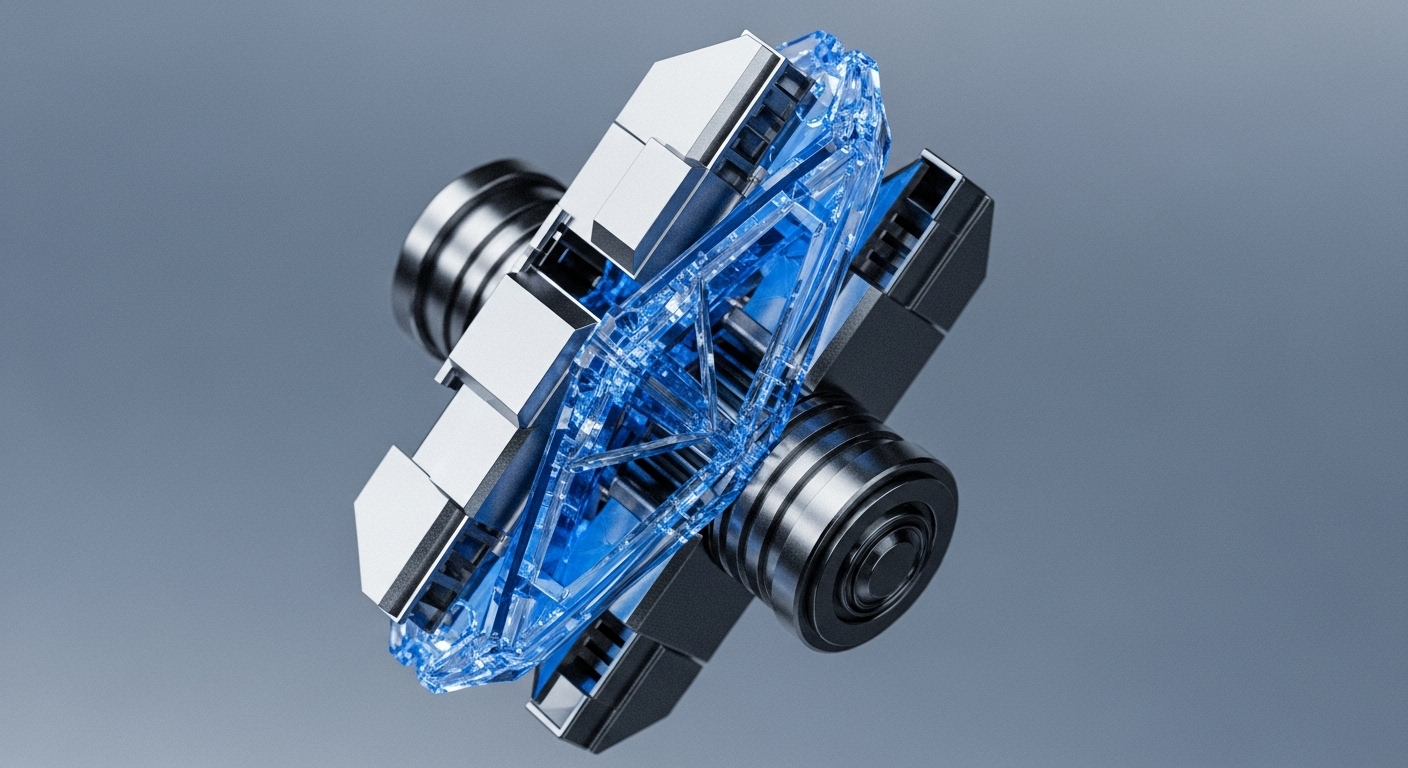
The image displays a complex, futuristic mechanical device composed of brushed metal and transparent blue plastic elements. Internal blue lights illuminate various components, highlighting intricate connections and cylindrical structures

Parameters

  • Core Concept → Sublinear-Space Zero-Knowledge Prover
  • Memory Reduction → O(sqrt(T)) from O(T)
  • Key MechanismTree Evaluation Problem Equivalence
  • Prover TypeStreaming Prover
  • Authors → Logan Nye
  • Publication Date → August 30, 2025

A luminous blue cube is integrated with a detailed, multi-faceted white and blue technological construct, exposing a central circular component surrounded by fine blue wiring. This abstract representation embodies the convergence of cryptographic principles and blockchain architecture, highlighting the sophisticated mechanisms behind digital asset transfer and network consensus

Outlook

This research establishes a critical foundation for expanding zero-knowledge proofs into new application domains, including pervasive on-device proving and privacy-preserving machine learning. The memory efficiency unlocked by this work will accelerate the development of truly scalable and private decentralized systems, fostering new avenues for research in cryptographic hardware optimization and novel protocol designs. The trajectory of this work points towards a future where verifiable computation is not a specialized capability but a ubiquitous element of digital interaction.
The image showcases a detailed, close-up perspective of a mechanical assembly, composed of gleaming silver and deep blue elements. Prominently featured within this intricate machinery are several irregularly shaped, translucent blue crystalline forms, reminiscent of ice

Verdict

This research represents a foundational advancement, dismantling a primary barrier to the widespread practical application of zero-knowledge proofs and fundamentally enhancing the scalability and accessibility of verifiable computation across all blockchain architectures.

Signal Acquired from → arXiv.org

Micro Crypto News Feeds

resource-constrained devices

Definition ∞ Resource-constrained devices are computing systems with limited processing power, memory, or battery life.

verifiable computation

Definition ∞ Verifiable computation is a cryptographic technique that allows a party to execute a computation and produce a proof that the computation was performed correctly.

proof generation

Definition ∞ Proof generation is the process by which participants in a blockchain network create cryptographic proofs to validate transactions or data.

zero-knowledge

Definition ∞ Zero-knowledge refers to a cryptographic method that allows one party to prove the truth of a statement to another party without revealing any information beyond the validity of the statement itself.

tree evaluation

Definition ∞ Tree evaluation is a computational process involving the assessment of data structures organized in a hierarchical, tree-like manner.

streaming prover

Definition ∞ A streaming prover is a component in zero-knowledge proof systems designed to generate proofs incrementally as data or computation becomes available.

decentralized systems

Definition ∞ Decentralized Systems are networks or applications that operate without a single point of control or failure, distributing authority and data across multiple participants.

zero-knowledge proofs

Definition ∞ Zero-knowledge proofs are cryptographic methods that allow one party to prove to another that a statement is true, without revealing any information beyond the validity of the statement itself.